

Full-Time Employee Installers vs. Subcontractors: Why It Matters
Serving Pleasanton, Dublin, Livermore, San Ramon, Danville, and Walnut Creek since 1997
Are subcontractor installers a problem for a home remodel? Not automatically. Subcontracting is common and legal in California, and plenty of subcontracted crews do good work. The real issue is what the arrangement changes for you as the homeowner: who is accountable if something goes wrong, how consistently the crew is trained, who carries the insurance, and who can place a claim on your property if someone in the chain does not get paid.
Those differences rarely show up in a quote. They show up two or three years later, when a window starts leaking at the sill or a siding seam opens up and you need someone to come back.
This guide explains how the two models work, where the differences actually matter, and how to verify a contractor's credentials in California before you sign anything.
How the two installation models work
Employee installers are on the contractor's payroll. The company hires them, trains them, schedules them, insures them, and is directly responsible for their work. When you sign with that company, the people who show up at your house work for the company you signed with.
Subcontracted installers are independent businesses or crews hired by the contractor for a specific job. The company that sold you the project manages the contract with you, then pays a separate crew to do the installation. That crew may work for several contractors at once and is often paid per job or per unit installed.
Neither model is a guarantee of good or bad work. But they create different incentives and a different chain of responsibility.
Where the difference shows up for homeowners
Accountability after installation
Window, door, and siding problems often surface after the crew has left. Flashing that was not lapped correctly, sealant that was stretched too thin, or a door frame that was not set square can take a season or two of Bay Area weather to reveal themselves.
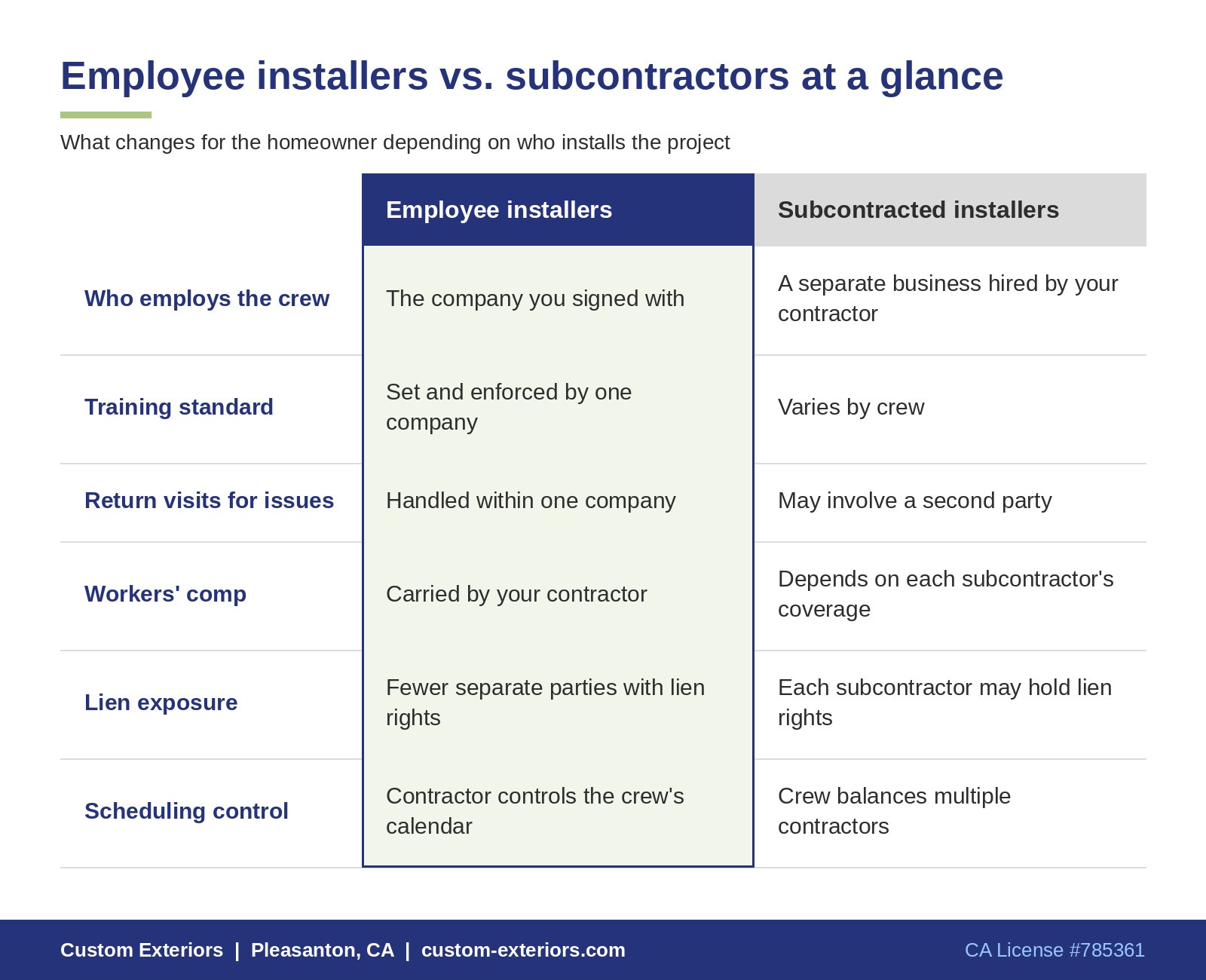
With employee installers, the company that sold the job also employs the people who did it. The company can look at its own crew's work, send someone back, and fix it within its own system.
With a subcontracted installation, the crew that did the work may no longer have a relationship with your contractor by the time a problem appears. The contractor is still responsible to you under your contract, but resolving the issue can involve a second party, a second schedule, and sometimes a disagreement about whose fault it was.
Training and installation standards
Premium products depend on precise installation. Window and door manufacturers publish installation requirements, and many warranties exclude damage caused by installation that does not follow them. A contractor with a stable employee crew can train every installer to one standard and hold them to it on every job.
A contractor that rotates subcontracted crews has less control over how each crew was trained and which shortcuts it takes when it is behind schedule.
Insurance and workers' compensation
When a worker is injured on a job, workers' compensation insurance is what covers it. California law requires contractors with employees to carry workers' compensation. Contractors who certify that they have no employees can currently file an exemption with the Contractors State License Board (CSLB).
That exemption is useful information for you. A company that says it uses its own installers but shows an exemption on the CSLB website is telling you, on a state record, that it has no employees. That does not prove anything is wrong, but it is a question worth asking.
The exemption is also going away. California law (SB 216, as amended by SB 1455) is scheduled to require workers' compensation for all licensed contractors, with or without employees, starting January 1, 2028. Until then, checking the record yourself is the simplest way to know what coverage is actually in place.
Mechanics liens
This is the risk most homeowners have never heard of. In California, subcontractors, material suppliers, and laborers who work on your project can record a mechanics lien against your home if they are not paid, even if you already paid your contractor in full. The CSLB describes this as the risk of paying twice.
Subcontractors and suppliers generally must send you a Preliminary Notice within 20 days of starting work or delivering materials to preserve those rights. If you receive one, it is not an accusation. It simply means that the party is part of your project and has lien rights.
The more separate businesses involved in your project, the more parties who may hold lien rights. You can protect yourself by collecting conditional lien releases before each payment and unconditional lien releases after it, from your contractor and from anyone who sent you a Preliminary Notice. The CSLB's homeowner's guide to preventing mechanics liens walks through each step.
Communication and scheduling
With employee crews, the company controls the calendar. With subcontracted crews, your project competes with the crew's other commitments. That is not always a problem, but it can explain why one contractor gives you a firm installation window and another gives you a range.
When subcontracting is normal
To be fair to the other side of this question, subcontracting is standard practice in construction. A general contractor building an addition will almost always subcontract electrical, plumbing, and other licensed specialty work, and that is appropriate.
The question is narrower for window, door, and siding replacement. On these projects, installation is the core of the job. The product arrives as a precision-built unit, and whether it performs as designed depends on the person who sets, flashes, and seals it. That is why it is worth knowing whether the installation itself is being handed off.
If a contractor does use subcontractors, that alone is not a reason to rule them out. Ask who the subcontractor is, check that business's license and insurance too, and make sure your lien releases cover them.
How to verify contractor credentials in California
You do not have to take any contractor's word for their credentials, including ours. Most of what matters can be checked in about 15 minutes.
1. Look up the license on the CSLB website
Use the CSLB license lookup with the contractor's license number or business name. Check:
- Status: The license should be current and active, not expired, suspended, or revoked.
- Business name and address: These should match the company on your proposal.
- Classifications: Make sure the license covers the type of work you are hiring for. For example, C-17 is the glazing classification, and B is general building.
- Bond: Licensed contractors must carry a contractor's bond. The standard amount is currently $25,000.
- Workers' compensation: Look for an active policy and carrier, or an exemption. Compare this to what the company tells you about its installers.
- Complaints or disciplinary actions: Any public complaint disclosures or legal actions appear on the license record.
Since January 1, 2025, a California license is required for any job of $1,000 or more in combined labor and materials, or any job that requires a building permit, regardless of price. Window, door, and siding replacement projects almost always cross that line.
2. Read the contract before you sign
California home improvement contracts must be in writing. The CSLB recommends that your contract include a specific description of the work, the materials to be used, the total price, and start and completion dates. The down payment cannot exceed 10 percent of the contract price or $1,000, whichever is less. Avoid paying in cash, and do not let payments get ahead of completed work.
3. Verify certifications at the source
Any contractor can list a credential on a website. Confirm the ones that matter for your project:
- EPA Lead-Safe certification: If your home was built before 1978, the firm performing the work must be EPA Lead-Safe Renovation, Repair, and Painting (RRP) Certified. You can search for certified firms using the EPA's certified renovation firm locator.
- Installer certifications: Window and door installer training through the Installation Masters program is now administered by the Fenestration and Glazing Industry Alliance (FGIA), formerly the American Architectural Manufacturers Association (AAMA). Ask which installers on your crew hold certification, not just whether the company employs someone who does.
- Manufacturer partner status: If a contractor claims a preferred or certified relationship with a manufacturer, the manufacturer can usually confirm it.
- Third-party ratings: Programs such as Diamond Certified publish their rated companies, so you can confirm a rating directly.
4. Read reviews for installation details
Star ratings tell you less than the content of the reviews. Look for reviews that mention the installers, the cleanup, and how the company handled a problem after the job. Reviews that name the same installers over several years are a good sign that the crew is stable.
Questions to ask any exterior remodeling contractor
Bring these to every consultation. A good contractor will answer them directly.
- Who will install my project: your employees or a subcontracted crew?
- If you use subcontractors, what are their business names and license numbers?
- Which members of my installation crew hold installer certifications?
- What does your labor warranty cover, for how long, and who performs warranty service?
- Is your workers' compensation coverage listed with the CSLB?
- Is your firm EPA Lead-Safe RRP Certified, and will you follow lead-safe practices in my home?
- Who is my point of contact from signing through the final walkthrough?
- Will you provide lien releases with each payment?
Why this matters in the East Bay
Installation quality is not a generic concern here. A few regional factors make it more important:
- Older housing stock. Many established neighborhoods in Walnut Creek, Lafayette, Oakland, Berkeley, and parts of Pleasanton and Livermore include homes built before 1978. Those projects require lead-safe work practices, and older openings are rarely perfectly square. Both reward an experienced, consistently trained crew.
- Inland heat and temperature swings. Hot summers in Livermore, Pleasanton, Dublin, San Ramon, and Danville put sustained stress on window and door seals and on siding joints. Installation details that hold up in a mild climate can fail sooner here.
- HOA and permit coordination. In HOA communities across Danville, Blackhawk, San Ramon, and Dublin, projects often need design approval before work begins. A single company managing the project end to end means fewer handoffs between approval, scheduling, and installation.
How Custom Exteriors handles installation
Custom Exteriors has served East Bay and Tri-Valley homeowners since 1997, with more than 30,000 completed projects. Every installation is completed by our own full-time employees, not subcontractors. Our team includes AAMA Certified Master Installers, and we are EPA Lead-Safe RRP Certified for work on pre-1978 homes. We are also Diamond Certified.
You can verify our record the same way we recommend verifying anyone else. Our California contractor license number is 785361, and our license record on the CSLB website lists our active license, bond, and workers' compensation policy.
That structure is why homeowners often mention our installers by name in their reviews. The people who install your Infinity by Marvin windows, ProVia or Therma-Tru entry door, or James Hardie siding work for us, are trained to our standards, and are part of the same company you call if you need anything after the job is done.
Learn more about our installation team and [why installation quality matters as much as the product](LINK: window installation process blog).
Frequently asked questions
Are subcontractor installers a problem for a home remodel? Not automatically. Subcontracting is common and legal. The concern is accountability, training consistency, insurance coverage, and lien exposure. Ask who will install your project, and if it is a subcontractor, verify that business's license and insurance as well.
How do I verify a contractor's credentials in California? Look up the license on the CSLB website to confirm status, classifications, bond, workers' compensation, and any complaints. Confirm the salesperson's Home Improvement Salesperson registration, verify certifications such as EPA Lead-Safe RRP at the source, and read the written contract carefully before signing.
How can I tell whether a contractor actually has employees? Check the workers' compensation section of the contractor's CSLB license record. An active policy is consistent with having employees. An exemption means the contractor has certified to the state that it has no employees.
Can a subcontractor put a lien on my house if I already paid my contractor? Yes. In California, unpaid subcontractors, suppliers, and laborers can record a mechanics lien against your property even if you paid your contractor. Collecting conditional and unconditional lien releases with each payment helps protect you.
What is the maximum down payment a California contractor can ask for? For home improvement projects, the down payment cannot exceed 10 percent of the contract price or $1,000, whichever is less.
Does Custom Exteriors use subcontractors for installation? No. Custom Exteriors installations are completed by our own full-time employees.
Talk to the people who will actually do the work
The best way to evaluate any contractor is to ask hard questions and check the answers. We welcome both.
Schedule a consultation to talk through your project, or visit our Pleasanton showroom at 2142 Rheem Drive, Suite E, to see windows, doors, and siding in person and ask our team anything about how we install them. You can also call (925) 249-2280, explore financing options, or view current offers.
2142 Rheem Drive, Suite E, Pleasanton, CA | (866) 568-4314 | custom-exteriors.com
Est. 1997 | 30,000+ projects | Diamond Certified | AAMA Certified Master Installers | Infinity from Marvin Platinum Partner

